


Advertising via digital channels has led to some changes in how companies communicate with customers. Yet just making ads is not enough.
The success of the ad can only be judged by the business organization itself.
How many qualified leads was the campaign able to generate? How many inquiries was it able to generate? Which target audience converted? Which type of creative worked better? Most importantly, did the investment made bring about business growth?
That’s when performance engine comes into play strategically.
While marketing strategies which concentrate on visibility do not necessarily emphasize much on the performance factor, performance marketing puts more value on results.
From Advertising Spend to Business Outcomes
An effective marketing campaign has to have an objective.
Depending on the nature of the organization, the goal of the organization may include:
- Lead generation
- Online sales
- Website inquiry generation
- Bookings/registrations increase
- App installs encouragement
- Creating high-quality remarketing lists
- Repeat purchases increase
The objective of the campaign will determine the design of the strategy, audience, creative, landing page, and the whole measurement approach.
In addition to asking “How many people have seen our content?,” companies need to ask:
“What business result has been achieved by the reach?”
The Right Audience Makes the Difference
An even good advertisement may fail if the target audience for this advertisement is wrong.
With performance marketing, companies are able to test various target audiences depending on criteria like demographic details, interests, behavior, intent, previous interaction, and customer data.
The objective here is not really about reaching the most people as possible.
Instead, it is about finding the right audience and continually optimizing for this depending on the results from the campaigns.
Creative Is a Performance Engine
Ads are not just visuals along with their messages.
The headline, message, image, video, offer, call to action and even the design can all impact people’s response to the ad.
Performance marketing requires constant testing of creatives.
For instance, a company can test:
Creative A: Product-oriented message
Creative B: Problem-oriented message
Creative C: Benefit-oriented message
Creative D: Social proof-oriented message
And get insights about what kind of communication will be relevant for the target audience.
In this way, the process of creating creatives becomes an educational process.
Landing Pages Can Make or Break Campaign Performance
Clicking on an ad is only the first step in the process.
Where you take them from there is crucial.
Should your landing page take a while to load, confuse the reader, or have nothing to do with your ad, then don’t expect the potential customers to stick around and do anything at all.
Here are some of the things that need to be consistent:
Ad → Message → Landing Page → Offer → Call to Action
Customers need to know straight away what it is that they are getting.
Measurement Should Go Beyond Clicks
Clicks have their usefulness in providing information; however, they are not the ultimate goal for most companies.
The performance measurement system will include the following sequence of stages:
Impressions → Clicks → Leads → Qualified Leads → Conversions → Sales
Afterward, companies are able to measure:
- Cost-per-lead
- Conversion rate
- Cost of customer acquisition
- Return on advertising spend
- Quality of leads
- Revenue generated
- Lifetime value of customers
It depends on the company’s business model and campaign goal what metrics to choose.
Optimization Is Where Performance Marketing Creates Value
Starting a campaign is just the tip of the iceberg.
The benefit lies in what marketers can do once the campaign starts providing them with data.
They can see which audience segments are resonating,
- which ads are performing,
- which placements are cost-effective,
- which keywords create more intent,
- where the potential customers are leaving,
- which campaigns need their budget tweaked.
The campaigns can then be optimized based on data and not on guesswork.
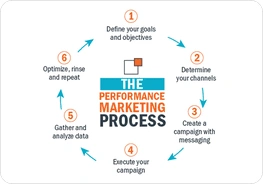
This gives rise to the following cycle:
Launch → Measure → Analyse → Optimise → Test → Scale
Technology Supports Better Decisions
The modern era of performance marketing is characterized by greater use of automation, analytics, and AI-powered tools for pattern recognition, optimization, insight generation, and campaign management.
But it’s important that technology aids marketing strategy, not substitutes it.
The business still requires a good position, offer, customer knowledge, and communication..
Data can tell you what happened. Strategy helps determine what to do next.
The Client Perspective Matters Most
For a client, performance marketing should not be something that just delivers a lot of data in the form of an impressive dashboard.
It should give answers to these business questions:
Where is our money going?
What do we get for it?
Who reacts to it?
What should we do better?
Where can we scale?
The moment marketing organizations start delivering clear answers to these questions, advertising becomes accountable and tied closer to business objectives.
Performance Marketing Is a Continuous Growth Process
Performance engine campaigns that are very strong are usually not created around a single ad.
They are developed continuously.
People change. Competition changes. There is creative fatigue. The expectations of the customers change. New technologies come out on the platforms.
This is the reason why performance marketing must be considered as a growth system, not as a campaign of advertising.
Companies which approach the paid marketing process with defined goals, proper metrics, testing and optimization can make advertising a controllable and measurable investment instead of a costly expenditure.
Final Thought
Performance marketing does not just mean spending less.
It means getting more out of every marketing expenditure.
Where there is measurement, there is insight; and where there is insight, there is an opportunity.